Blog

A Word from the Designers Company News HutJet Showroom Interview Prefab Philosophy Real Cases The Architect's Code Venya will show
A House in 3 Weeks: How HutJet’s Engineering Technology Is Displacing Traditional Construction
This fall, HutJet returned to the All-Ukrainian Construction Congress, and the event clearly demonstrated that the company is moving forward at a pace the market is only beginning to respond to. After the summer debut with a compact ready-made house, this time HutJet presented a solution of a completely different scale—more complex in execution, more impactful in content, and significantly more telling for the entire industry.House production began less than a month before the congress. After developing control programs, the process entered a clear sequence: the six-axis Weinmann beam center manufactured the main frame elements and terraces, other woodworking equipment produced structural details, and the quality control team monitored the precision of each joint. The frame was formed with consideration for subsequent engineering integration, and thermal insulation was installed so that the house would maintain stable temperature and remain energy-efficient.While craftsmen assembled the structures, engineers installed heating, ventilation, water supply, sewage, electrical, and Smart House systems.All utilities were laid before finishing—this allowed avoiding on-site modifications and ensured an aesthetic, complete appearance. When the engineering became part of the structure, it was tested in normal mode: circuits were connected, underfloor heating was run, lighting, ventilation, and smart home scenarios were tested.After production completion, three residential modules were lifted by crane and installed on trailers. The team checked the fastenings, balanced the load, and prepared the route. In the evening, the convoy departed for the Parkovy Exhibition Center. The night journey required precise adherence to schedule and safe coordination of all equipment.On-site assembly began immediately. The crane unloaded the modules onto the platform, after which the team proceeded to connect the house. Load-bearing parts were joined according to the project, geometry was checked, floor and roof joints were connected. Then engineering integration between modules was performed and all systems were launched in operating mode. The house underwent complete inspection—from underfloor heating to ventilation and plumbing. All work was performed carefully and harmoniously: without dust, without excessive noise, and without the chaos that often accompanies traditional construction.After technical completion of assembly, a cleaning team entered the house. They arranged everything in place, removed construction dust, and prepared the interiors for decoration. Decorators worked next: they hanged textiles, emphasized features, completed compositions for living rooms, bedrooms, and terraces. The house finally acquired the appearance of a living space ready to receive guests.The prefab Lake house demonstrated that a residential home can complete the entire journey—from project to finished exhibition—within clearly defined timeframes and without the disorder characteristic of construction sites. Factory preparation, controlled production, thoughtful logistics, rapid assembly, and final decoration work formed a complete product ready for use immediately after installation.https://www.youtube.com/watch?v=45sea9FazIoAt the All-Ukrainian Construction Congress, Lake became one of the most visited exhibitions of the day. HutJet proved that next-generation housing doesn't need to be imagined—it can be seen, felt, and evaluated in real conditions. The company is establishing a standard where homes are quickly produced, precisely assembled, and confidently put into operation.Even more ambitious solutions lie ahead.Subscribe to the HutJet YouTube channel and follow the development of our technologies in real time.

HutJet — Prefab House Manufacturer of the Year according to Ukrainian Building Awards 2025
On December 18, at the Hyatt Regency Kyiv hotel in the heart of Kyiv, the Ukrainian Building Awards ceremony took place — one of the key industry awards recognizing companies and projects that set new standards in Ukrainian construction.The event brought together leading developers, architects, manufacturers, city government representatives, and market experts — those who today determine the direction of residential and urban development in Ukraine.The award was organized by DMNTR media group. General information partners — Interfax-Ukraine and FOCUS.This year, Ukrainian Building Awards recognized participants from various industry segments — from development and architecture to urban development and construction innovations. The award reflected the profound changes currently taking place in the market.Among the laureates — HutJet.The company operates under an industrial model where housing is perceived not as a lengthy construction process, but as a complete engineering product with a clearly defined result. HutJet prefab houses are manufactured at the factory with full quality control, engineering solutions, and equipment before delivery to the location, ensuring predictability, stability, and high quality of the finished housing.It was for this model that HutJet received the award "Innovative Prefab House Manufacturer of the Year." The award was received on behalf of the company by HutJet Commercial Director Oleksandr Stepanytsia.Commenting on the event, he emphasized that the award is recognition of the company's systematic approach:For us, this is about industry trust. We launched the factory and serial production only in 2024, but we already see the market's readiness to perceive prefab housing as a complete, mature product. This is an important signal — both for the team and for partners.HutJet emphasizes that the essence of the prefab approach lies in complete process control, stable result repeatability, and the ability to scale production without compromising quality standards.Summarizing the year, HutJet Commercial Director Oleksandr Stepanytsia thanked the award organizers for creating a professional platform for open dialogue and industry development:We are ending the year with defining and landmark events. We are grateful to Igor Parubsky for the idea, organization, and vision that shape a new culture of industry eventsFor HutJet, this award is not the finale, but a logical stage of progress. The company is planning to develop the model range, scale production and further shape the industrial housing culture in Ukraine.
Oleksandr Stepanytsia: Hotel infrastructure should be manufactured, not built
On December 12, the forum "I Build a Hotel 3!" took place at Emily Resort near Lviv — an event that brought together hotel business owners, developers, investors, and resort and hospitality property operators.Among the forum speakers were Andriy Fedoriv, founder and CEO of Fedoriv Group, one of the key strategists in branding and marketing transformations in Ukraine, as well as Yaroslav Korniyachenko, an expert in development and operational management of hotel real estate.One of the key presentations was the speech by HutJet Commercial Director Oleksandr Stepanytsia, dedicated to transforming the approach to creating hotel infrastructure.In his presentation, Oleksandr Stepanytsia proposed a fundamentally different framework for discussing hotel development — not through individual technologies or products, but through changing the model itself. According to him, the hotel business already operates with flexible pricing logic, quick decisions, and variable demand, while infrastructure often remains slow, inflexible, and overly dependent on contingencies.The key thesis of the presentation was clear: the traditional construction model systematically fails to meet modern hospitality market requirements. The reason is not war or crises, but the very nature of the process: scattered responsibility, unreliable quality, dependence on weather and human factors, lack of predictable timelines and budgets.HutJet's Commercial Director emphasized that this problem is not local — similar logic works in Europe, the USA, and Israel. Therefore, the solution lies not in optimizing the old system, but in replacing it.The problem is not who builds. The problem is that we are still trying to build what we should be manufacturingIt is from this logic, according to Oleksandr Stepanytsia, that HutJet emerged. The company completely abandoned the chaotic construction process in favor of an industrial model, where housing and hotel modules are the result of manufacturing, not struggling with circumstances. Control, standards, repeatability, and clear timelines in this system are basic product parameters.https://www.youtube.com/watch?v=2sChz9qMOSMSpecial emphasis in the presentation was placed on flexibility as a key value for the hotel business. HutJet spaces can change scale, configuration, and even location: modules are added, disconnected, adapted to changing demand or business models. This same logic underlies trade-in, lifetime structural warranty, and the approach to the complete product lifecycle.As an example of practical implementation of the HutJet system, Oleksandr Stepanytsia cited several projects. Specifically, the Lake house — a fully ready villa with an area of over 130 m², manufactured in less than a month and assembled on location in a matter of hours. As well as the resort project Shypit Spa & Resort in the Carpathians, where thirteen houses were implemented in challenging mountain conditions without schedule delays or quality loss.https://youtu.be/e1QfVRZpCEQ?si=4Wa6o8AJiclGalIzSeparately, HutJet's Commercial Director emphasized the importance of energy efficiency and autonomy for modern hotels. The company's products are certified as class "A" energy efficiency and can operate autonomously — with integrated solar panels, battery systems, generators, and centralized Smart House management.Concluding his presentation, Oleksandr Stepanytsia outlined HutJet not as a separate technology, but as a complete business system for developers and hoteliers — from concept and manufacturing to logistics, launch, and operation.Future development is measured not in square meters, but in precision and time. HutJet transforms homes and hotel rooms into technological products — predictable, scalable, and manageableThe presentation by HutJet Commercial Director Oleksandr Stepanytsia at the "I Build a Hotel 3!" forum became a clear professional statement about the need to restart the industry — and at the same time practical confirmation that a different model of hotel development is already working.
HutJet Opens Production to Top Developers: Response to Timeline and Quality Crisis
On November 22, the day after the All-Ukrainian Construction Congress, HutJet invited the professional development community to its production facility in Brovary. This was not a tour in the classical sense, but a continuation of the conversation about the future of housing—in a format where processes, technologies, and ready solutions speak instead of words.During the visit, guests familiarized themselves with the key stages of prefab module production and saw how HutJet's factory approach gives developers control over timelines, budget, and quality—without scattered contractors. Special attention was paid to how these solutions scale for different development project formats and work in the real economy.Beginning of the MeetingAt 11 AM, the HutJet team welcomed guests at the main entrance of the factory in Brovary. Before the program began, participants had the opportunity to communicate in an informal atmosphere, take some photos at the brand wall, and chat over coffee in the welcome zone.Soon after, HutJet founder Sergiy Samusev joined the guests. He personally greeted everyone, thanked them for their interest in the production, and addressed them with a brief introductory speech, outlining the main idea of the meeting: to show not a concept, but an already working model of industrial housing creation.The Path of Creating a Prefab HouseAfter this, the group, led by Sergiy Samusev, set off on a tour of the production facility. The company's founder guided guests through the entire path of creating a future home—from initial material processing to finished modules.The first stop was one of the factory's key assets—the 6-axis beam center. This is where high-precision wood cutting takes place: an automated system sets parameters, and equipment performs processing with millimeter accuracy. This ensures perfect geometry of parts and allows modules to be assembled without distortions and gaps at the final assembly stage.Next, participants moved to the assembly tables—specialized workstations where the framework of future modules is formed. Here the team works with structures, insulation, and preparation of elements for further completion. These tables guarantee geometric precision, layer density, and result repeatability.Nearby is the furniture workshop, where kitchens, cabinets, and other built-in elements are manufactured, which are later integrated directly into the modules.Along the way, Samusev also showed several projects that were already in the final stages of production: some modules were completing the production cycle, others were already being prepared for shipment and transportation. Guests carefully observed the processes, asked technical questions, and were interested in the details of production organization.This level of openness evoked a lively response from the professional audience."I don't know if this is your first production facility, but it looks very powerful and organized. I won't attempt to evaluate the technological map, but what I see is a high level. Well-prepared nodes, assembly tables. Thank you for setting a new standard in Ukraine," noted Yaroslav Korniyachenko, Founder & CEO of Vlasne Misto.For some, the tour became not only an introduction to technology, but also an answer to a broader question—how such solutions can impact the country in the near future."This is the future. We have many challenges and tasks, particularly related to relocation and the return of military personnel. We need to create housing quickly. We don't have time to wait for years. And such projects are the answer to how this can be done. It's aesthetic, fast, and well thought out," shares military officer Alexander.From Tour to DiscussionThe production tour concluded near the SPA complex, which the team planned to deliver to the western part of the country a few days after the event. That day it became an improvised stage for the conversation that guests were particularly anticipating.In an open discussion, Sergiy Samusev, founder of HutJet, and Evgen Bokiy, commercial director of UDP, came together. The dialogue immediately set the tone for the event: two industry development strategies—complete housing industrialization and gradual modernization of traditional approaches—met in lively discussion.Samusev emphasized the need for rapid and systematic transition to factory format with predictable timelines, controlled quality, and transparent processes. Bokiy, for his part, focused on the realities of the development market and the importance of evolutionary implementation of changes.Eventually the conversation evolved into a constructive dialogue about the pace of industry transformation and technologies that can already work on a large scale today.Strategic continuation of the topic took place within a panel discussion featuring:Alexander Stepanytsa, CBO HutJetYaroslav Korniyachenko, Founder & CEO Vlasne MistoKonstantin Pisarenko, Founder The CapitalTaras Harashchak, founder of Harashchak Engineering Group and co-founder of ProRopp EstateViktor Kyrylkin, founder and CEO of "Nova Dacha"The moderator was Alexander Loktionov, founder and CEO of RITM Group.The discussion focused on the key issue: how developers, architects, and market operators see the industry transformation in the coming years—from changing project logic to new standards of quality, timelines, and economics. Participants reached a common conclusion: the demand for controlled, industrialized solutions has already formed, and the market is preparing to work with them systematically.HutJet's PositionAfter the intensive discussion, a logical question arose: what conclusion does the HutJet team itself draw? This was answered by the company's commercial director Alexander Stepanytsa."I personally became convinced that we are moving in the right direction. The entire discussion was essentially about those problems that HutJet already solves. They are acute and relevant for the market. Our solutions are innovative, and today this is our significant competitive advantage."The event became a clear signal to the market: prefab is no longer an alternative path, but a technological standard that forms new rules of efficiency and quality. HutJet demonstrated production capable of scaling housing with the same precision with which industry creates complex engineering products.https://youtu.be/Wd0dxU1lTxU?si=806aVmQQkSHVuFv8Sergiy Samusev and the team confirmed their position not with words, but with real results. The event concluded—the future holds concrete steps and collaborations that are already awaiting implementation in the production schedule.Subscribe to the HutJet YouTube channel to continue seeing how the new housing industry is born.
HutJet Founder Delivers Verdict on Construction! The Era of “Long Builds” Is Over
On November 21, the Ukraine Building Congress took place in Kyiv—an event that traditionally sets the tone for professional discussions about the future of the construction industry in Ukraine. Every year, the congress brings together several thousand participants and becomes a platform not only for discussing projects and technologies, but also for rethinking the very logic of housing creation in the context of a new economy, wartime challenges, and global changes.In 2025, this dialogue went beyond theory. For the first time at the Congress, the thesis about the industry's transition from process-based construction to industrial housing production was articulated so clearly—with factory precision, predictable timelines, and systematic quality. This shift became the central theme of HutJet's participation in the event.The company did not limit itself to demonstrating the concept. HutJet brought a ready-made prefab house and simultaneously opened a public conversation about why the construction industry can no longer operate under the old rules. The speech by company founder Sergiy Samusev became a logical continuation of this demonstration—and one of the most discussed moments of the congress.A Speech That Questioned the Industry's Very LogicIn his speech, HutJet founder Sergiy Samusev proposed looking at development more broadly—not as a set of separate projects or technologies, but as a fundamental function of creating an environment for life. He began unexpectedly—with a brief historical analogy.Addressing his colleagues, Samusev suggested thinking about who was the world's first developer. The answer, according to him, lies in the original sources—in the logic of creation: first the earth, then space, and only after that—humans as users of this environment.This example became a metaphor for the main idea of the speech: development is not only about square meters, but about responsibility for the way of life that is formed under such conditions.When Experience Forces a Reconsideration of ApproachesWith over 30 years of practical experience in the industry, Sergiy Samusev directly outlined his position: the housing creation model that dominates today has exhausted its development potential.In his opinion, in a world that has already transitioned to the sixth technological paradigm, the housing industry continues to operate according to logic formed decades ago."We live in times of radical technological change, but the construction process has practically not evolved. This is not only Ukraine's problem—they work the same way in Europe, the USA, Israel. Everywhere I've seen construction sites, the process remains too slow and poorly managed."Samusev emphasized: in the traditional model, it is impossible to achieve three key things simultaneously—predictable timelines, stable quality, and controlled budget."When you start construction, you can only be sure of one thing: it will never be completed within the timeframe you expect, and it will never cost what you hope for."From Process to ProductThe key thesis of the speech was a call to change the very approach to housing creation. According to the HutJet founder, the industry must transition from site-based processes to an industrial manufacturing system."Everything that surrounds us—living spaces, offices, entire complexes—should no longer simply be built. They need to be manufactured."It was from this logic, according to Samusev, that the HutJet project emerged."HutJet is both a product and a factory. I hope that over time this will become the name of a new category that will find its place between classic development and industrial production."This is not about an alternative to the traditional market, but about a different level of organizing housing creation—with clear rules, understandable stages, and predictable results.The first principle is predictability.According to Sergiy Samusev, the instability of timelines and results is the biggest weakness of the traditional approach. In factory conditions, these risks are eliminated: processes become manageable, and results become predictable."What is impossible to handle under classic conditions becomes manageable in production. We eliminate randomness as a phenomenon."The second principle is housing mobility.Houses should not be rigidly tied to a specific plot. In HutJet's logic, each prefab house can change location along with the owner's or project's needs.The third is systematic quality, which is impossible to achieve without complete control of the technological chain."Uncompromising quality is only possible where every stage is under control. This is a fundamental issue and one of the main reasons why we work specifically in a factory format."No less important element, Samusev named a different attitude toward time. If in the classic model timelines are counted in months and years, at HutJet they are measured in weeks—with a clear prospect of further cycle reduction.Special emphasis was placed on autonomy and energy efficiency. In modern conditions, housing must remain functional even in the absence of external networks."Each house can be completely autonomous while remaining fully suitable for living."From Concept to ImplementationTo confirm that this is not about an abstract idea, but about an already working model, HutJet presented a ready-made prefab house Lake at the Congress, assembled directly on the territory of the "Parkovy" Exhibition Center.The house was put into production at the beginning of the month. Within just a few weeks, it underwent complete technical verification, after which it was delivered to Kyiv and assembled in one night."This is a completely ready space. You can enter it and live—without additional work, connections, or modifications."The house demonstrated the key characteristics of HutJet's industrial approach: integrated engineering, system management, thoughtful ergonomics, and a high level of energy efficiency—significantly lower than average indicators for urban housing.Housing as a Product of the New EraAt the conclusion of his speech, Sergiy Samusev drew attention to the broader context of changes already occurring in society and the economy. According to him, in a world where decision-making is increasingly based on data and trust, classic promotional tools are losing influence."In the near future, competition will come down to two things—product quality and the level of trust in the brand."According to Samusev's assessment, the industry is already at a point of transformation. Part of the market feels this, part does not yet, but changes are inevitable.https://youtu.be/SSUidQD2iEM?si=pJEhEj5L03rT0vkiThe full version of Sergiy Samusev's speech from the All-Ukrainian Building Congress can be viewed on HutJet's official YouTube channel.
A House Instead of a Stand! How HutJet Became the Main Event at Ukrainian Building Congress
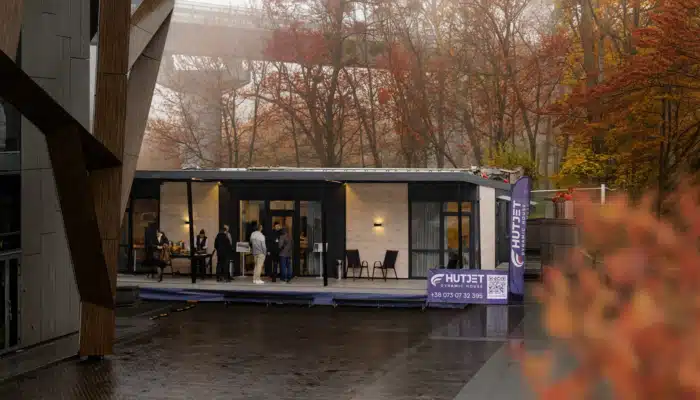
HutJet participated in the All-Ukrainian Building Congress for the second time, but this time it was a completely different level of conversation with the industry. If in summer the company surprised the market by bringing not a stand but a compact house in ready-to-use condition to the event, this time it impresses with the scale of its capabilities. Throughout the day, the prefab house with an area of over 130 m² worked continuously right next to the Parkovy Exhibition Center, welcoming thousands of guests. They could go inside, test the engineering, ergonomics, furniture, and smart systems exactly as future residents would do. This was not a demonstration model or a "for example" showcase — this was proof that housing can be manufactured with the precision of a technological product and delivered in ready-to-use condition.That day, HutJet underwent testing before the market's eyes: did the technology withstand the scale, attention, and expectations of the professional community? What was this day like for the team, with what ambitions did company founder Sergiy Samusev come here, and how did guests react to the house of the future — find out belowAlready at , the exhibition prefab house Lake opened its doors to the first congress guests. The HutJet team invited developers, architects, engineers, and partners to view the space as a ready residential product. Guests' attention was drawn to the engineering systems, factory furniture, finished interior, and thoughtful planning.Visitors appreciated:ergonomics and logic of room layout;operation of ventilation and plumbing systems;acoustic properties of modules;quality of facades and structural joints.It is precisely such technical details that build trust in the technology — and that day they were openly accessible.After touring the house, guests were invited to the main stage of the Parkovy Exhibition Center, where HutJet founder Sergiy Samusev presented his vision of the future of industrial housing.Today, when we have already entered the sixth technological paradigm, construction continues to operate according to medieval logic. This applies not only to Ukraine — in Europe, America, Israel, construction processes remain equally slow. Everywhere I have observed construction, it moves equally slowly and clumsily. My proposal to the world is to move to the next level and manufacture housing the way we do it at our factory. What I'm talking about is the HutJet project. HutJet is both a product and production simultaneously. And I hope that this model will become a new category between current construction and modern manufacturing.https://youtu.be/SSUidQD2iEM?si=BBSfXZm91ydY_bBPSamusev outlined the main thesis: traditional construction is technically exhausted, and the future lies in factory manufacturing of housing, where quality, timelines, and budget are controlled from start to finish.The position of HutJet's founder was also supported by guests who personally tested the Lake house.The best impressions. On the quality of the house, on its appearance, on the technical component. Also on the architectural solution itself. Overall, it's all reasonable, practical, and convenient , - shares his impressions Yuriy Korzhevsky, head of "Zoloche Group of Companies"His opinion is continued by Pavlo Pysarenko, head of the plumbing department at Geberit company. Pysarenko notes that the solutions offered by HutJet are indeed capable of formulating an alternative to traditional construction:In general, modular construction is rapidly gaining popularity now, and we clearly see that this is the future. First of all, it's speed: you can literally move into your dream home in three months. For Ukraine, this is especially relevant, as we have a serious housing deficit, and therefore modular solutions already carry a social function. Towns for displaced persons, frame construction — all this shows that such formats really work. And I am convinced that the future lies precisely in such technologies.Professional assessment goes beyond purely technical parameters — it's important how comfortable the space will be for the future resident. This is emphasized by Halyna Bondarchuk, project department manager at Geberit company:Having looked, I've also been in construction for quite a long time, I see that this is really quality. This is not just cobbled together from whatever was available, you can really see the work, see the professionalism, and it looks quite comfortable and cozy.Ultimately, any solution must meet market expectations in terms of appearance, price, and quality. This is precisely what Viktor emphasizes, head of sales department at a construction company:I observe and look at such construction formats a lot in general. Honestly, I liked that it's made of wood and mineral wool, because I know they build with different materials. And they foam with something, unclear what, various SIP panels. The construction format itself is cool and generally pleasant. Pleasant color scheme, not stressful. Just such a cool little house and by the way for very reasonable money, considering that it comes with renovation and can be made in three months.During the discussion, a guest asked a question about logistics. At this time, Sergiy Samusev joined our conversation to personally explain all the nuances.He explained that in just two days, the house traveled from finishing work at the factory to installation near Parkovy. The house consists of three modules, and the terrace and awning were transported together with them — in total on three trailers.Indeed, the prefab house Lake was manufactured at the factory a month before the event. A few days before the congress, it was delivered and assembled in the parking lot of the Parkovy Exhibition Center literally overnight.At the end of the day, we managed to speak with HutJet's Commercial Director Oleksandr Stepanytsia. According to him, participation in the Congress for HutJet is primarily about dialogue with the market and expanding professional connections, not just presenting technologies.I expect to debunk myths about modular construction, make new contacts, and introduce people to the HutJet brand. We are a young company, and I want people to see and get acquainted with this technology here at the Building Congress.This day, the HutJet team spent in open dialogue mode with the industry: showing solutions, answering all questions, building new contacts and partnerships. Calmly. Professionally. To the point.https://www.youtube.com/watch?v=PVvbltmM0XsSergiy Samusev himself from the Parkovy stage only reinforced what guests saw today: HutJet is a team that knows the direction and moves systematically in it every day. The Congress ends, and for the company, the implementation of new agreements begins.More about HutJet on our YouTube channel. Subscribe so you don't miss the company's next steps — the most interesting is ahead.
“this is an Alternative to Standard Modular Solutions”: Developers about HutJet at UIC
On July 31, the key event of the investment, development, and architectural year took place at the Parkovy Exhibition Center — the Ukrainian Investment Congress. Among hundreds of companies, HutJet became the brand that outlined a new architectural paradigm where technology, design, and mobility combine into a unified system.The company served as the general sponsor of the Congress and presented not only the concept but also the finished result — a two-module HutJet house assembled on the Parkovy territory in less than a day. Visitors could personally evaluate the space, see the Smart House system in operation, communicate with the team, and later share their impressions.Igor Chudovsky, who has long been following the prefab solutions market, saw in HutJet a real alternative to traditional construction:- I like the speed of execution. You just need to have a plot. In wartime conditions, this is extremely convenient. In any case, it's modern and promising.https://youtu.be/yku1g8uidcs?si=K71EmEFqyxJXRcIfHis opinion is also supported by another Congress participant — Vyacheslav Syty:- It's better to focus not on the cost of construction, but on the cost of a year of your life. 12 weeks — and you're already living. This is better than a year of renovation.https://youtu.be/qiSKxbKAUQk?si=l9YiDxakysgvXvKZHutJet interested not only private owners but also developers. Anastasia Yermalyuk plans to implement a large-scale cottage village project:- We need 10–20 such houses. This is an alternative to the standard modular ones that exist now.In addition to business ideas, Anastasia also shared her personal impressions of the HutJet exhibition house:- I liked the content, the price is reasonable. If there is in-house production, it means quality is under control, emphasizes Yermalyuk.https://youtu.be/tntRAjQ2JVE?si=F10MyzBfKzpspUsfAt the Congress, HutJet became a platform for discussions about a new quality of housing. For some, it showed the possibilities of quick solutions today, for others — the prospect of large-scale projects. But for everyone, it became confirmation that modern construction technologies go beyond concepts and transform into tangible experience.
HutJet Installed a House in just 12 Hours before the Eyes of Ukrainian Investment Congress Guests!
Bringing a real house to an investment congress and assembling it in 12 hours? For HutJet, this is reality, not a challenge. At this year's Ukrainian Investment Congress, HutJet presented not a stand or a model, but a full-fledged prefab house of the Shift model with an area of over 50 m². It was installed right in the parking lot of the KVC 'Parkovy' — on the eve of the opening of the year's largest investment event.How it HappenedPreparation started a day and a half before the event at the HutJet factory in Brovary. Two residential modules, fully ready with interior finishes and engineering systems, were loaded onto trailers using a crane. Each fastening was checked with particular care: precision to the centimeter is crucial in such a journey.Late in the evening, the convoy arrived in Kyiv. The installation site was the parking lot near the main entrance to 'Parkovy', where the first guests of the Congress were to be welcomed in a few hours. The assembly team installed the modules on the chassis, and a tractor carefully pulled them into their final position.12 Hours for AssemblyThe subsequent work resembled a well-coordinated construction set:connected the load-bearing frames and roofing units,joined the finishing elements,connected electricity, water, sewage, and ventilation,set up the 'smart home' system and climate control.Importantly, the installation took place without noise, dust, or chaos — using HutJet's own technology, which completely distinguishes prefab production from classical construction.The next day, a cleaning company and decorators entered the site. They arranged furniture, added textiles and decor highlights. By the opening of the Congress, the house looked as if it was already ready for its ownersLive ExhibitThroughout the day, the house became a true interactive exhibition. Guests could either enter, evaluate the interior, check the functionality, and also receive consultations from HutJet's technical specialists and managers.Return to LifeWhen the event ended, the team received another task — to pack everything back in record time. At night, the modules were disconnected, engineering systems were unplugged, roof and floor joints were disassembled, and everything was loaded back onto the trailers.In the morning, the convoy was already on its way to the Carpathians — to the new owner of Shift.HutJet Technology in ActionThis demonstration showed the main idea of HutJet: a house can be brought, assembled, shown to thousands of people, disassembled, and installed again — quickly, cleanly, and without compromising on quality.https://www.youtube.com/watch?v=APOMPCRF4sA&t=1sThis is what the future of housing looks like: mobile, technological, and ready for living immediately after installation.
HutJet at Ukrainian Investment Congress 2025: Architecture of a New Era in Action
On July 31, the key event of the investment, development, and architectural year took place at the Parkovy Exhibition Center — the Ukrainian Investment Congress. Among hundreds of companies and ideas, HutJet became the brand that defined a new architectural paradigm where technology, design, and mobility become one.The company served as the general sponsor of the Congress and presented not just a concept, but a ready result: a two-module HutJet house assembled on the Parkovy territory in just 12 hours.An Exhibition that Creates ExperienceCongress guests personally familiarized themselves with HutJet's architectural idea in its completed form: they entered the house, felt the space, saw the Smart House system in operation, and spoke with the team.Public Premiere of HutJet PhilosophyIn the main hall, designed for approximately one thousand viewers, the official brand presentation took place. The program was opened by Yulia Ryzhykova, HutJet's Marketing Director, who outlined the company's vision as a leader of new aesthetics and functionality in residential space.The key event of the day was the speech by HutJet founder Sergiy Samusev — an entrepreneur who worked in traditional construction for decades and now leads the market transformation:"I saw how projects dragged on for years, how contractors disappeared, how promises remained on renders. One day I decided: enough construction. Time to manufacture. That's how HutJet was born."This speech set the tone for the discussion about the industry's future — and its responsibility to society.Direct Dialogue with the MarketAfter the brand founder's speech, a Q&A session with the HutJet team took place.Key company figures participated in the discussion:Sergiy Samusev — HutJet founder, strategist and visionary who shapes not only the product but also a new philosophy of life. His ideas break patterns and change the market. Andriy Podilchuk — HutJet's chief architect, author of spatial solutions that match the rhythm of modern life. He embodies the concept of mobile, adaptive architecture. Yevhen Ulyanov — HutJet's technical director, who manages the company's engineering core. Responsible for implementing technologies that ensure autonomy, efficiency, and full functionality of HutJet houses. Yuriy Shparyk — head of legal affairs. Ensures transparent and protected interaction with clients, partners, and investors. His work is the legal foundation of HutJet. Yulia Ryzhykova — HutJet's Marketing Director. She defines the company's positioning in public space and manages all external communications of HutJet.Developers and investors asked direct questions — about scaling, energy autonomy, franchising, logistics.The HutJet team not only answered — it opened a professional dialogue about new rules of the game in the market.The public program concluded with Sergiy Samusev's participation in the panel discussion "Investment in Development," where together with other leading speakers they discussed new space formats, the role of the private sector in urban transformation, and tools for attracting investment in residential infrastructure. This discussion became a worthy finale to the day, in which HutJet appeared not simply as a product, but as a strategy that sets a new direction for the entire industry.
How HutJet is Transforming the Market: Press Conference before the Ukrainian Investment Congress
On July 28, a press conference was held at Interfax-Ukraine agency ahead of the Ukrainian Investment Congress. The Congress will bring together business leaders, government experts, architects, developers, and investors — becoming a platform to discuss solutions that can not only rebuild the country but also transform its approach to space, infrastructure, and life.Special attention at the press conference was drawn to the speech by Serhii Samusiev, founder of HutJet — the company serving as the general sponsor of the event. In his speech, Samusiev shared the transformation story that underlies the HutJet concept:Over decades in the construction industry, I've seen projects drag on for years, contractors disappear, and beautiful renders having nothing in common with reality. One day I realized: it was time to forget about construction and move to manufacturing. That's how I created HutJet.According to Samusiev, HutJet is more than just prefab housing. It's a new philosophy of space: mobile, autonomous, technological architecture that changes the perception of home and offers a new infrastructure culture.HutJet's innovative idea resonated with the audience. The conference moderator Andrii Dlihach, founder of Advanter Group, emphasized:We need to position Ukraine as an experimental platform: dynamic houses, new living spaces, new logic of infrastructure and urban planning. Business is waiting for systemic changes and transparent rules of the game.Among the speakers were:Nazarii Volianskyi, Director of Government Relations at Unimot S.A., who reported that over 3,500 Polish companies are ready to invest in the Ukrainian economy;Yaroslav Korniiachenko, CEO of "Vlasne Misto" development company, who emphasized the importance of creating a transparent investment climate and quality work of municipal teams on the ground;Vladyslav Mykhailenko, lawyer and public figure, who raised the topic of legislative instruments for investor protection and new formats of public-private partnership.The press conference served as a prologue to the main event — the Ukrainian Investment Congress, which will take place on July 31 at the Parkovyi Convention CenterHutJet at the Ukrainian Investment Congress: when and how to JoinDuring the Congress, HutJet will showcase a completed two-module house, which was assembled in just 12 hours before the event right on the territory of Parkovyi. Throughout July 31, the house will be open to visitors — you can step inside, evaluate the quality of materials, space ergonomics, see the Smart House system in action, and interact with the team.HutJet's program of presentations is led by Serhii Samusiev, who will present the brand philosophy and technology of the future:11:15 a.m. — Welcome Address Yuliia Ryzhykova, Marketing Director at HutJetChasha Hall12:15 p.m. — Main Presentation Serhii Samusiev, Founder of HutJet Chasha Hall1:00 p.m. — Open Q&A Session Lux Hall5:25 p.m — Panel Discussion "Investments in Development" Serhii Samusiev — among invited speakers Chasha HallThe Congress will gather over 6,000 participants — developers, architects, bankers, politicians, and investors from Ukraine and Europe. HutJet will be at the center of this conversation as an example of how private initiative can transform an entire industry.Parkovyi Convention Center, 16a Parkova Road, KyivDate: July 31 at 09:00 a.m.HutJet is more than a home. It's a response to society's demand to live differently.https://youtu.be/_4kB_6fZuN0
From Sketch to Reality: how a HutJet House is Born — Refined and Ready for Life
We will tell you about the entire process — transparently and step by step. So you understand how and from what your future home is built. From idea — to a completely finished space.1. Architectural design — birth of an ideaAt this stage, we get to know the client, their lifestyle and needs.Architects help select a model, adapt it for the family, considering not only current but also future requirements. This is where the final appearance of the house and all technical documentation for production are formed.2. Construction preparation — beginning of productionThe project is loaded into robotic systems — including a 6-axis beam center. Machines cut frame elements with micron precision. Eliminating the human factor at this stage is a guarantee of quality, accuracy and durability.3. Material inspection and treatment — guarantee of durabilityWe carefully inspect every cubic meter of timber. Materials undergo deep fire and bio-protective impregnation in special baths. Chamfering additionally strengthens the frame and reduces fire risks.4. Frame assembly — the heart of the houseThe frame is filled with basalt wool — this guarantees warmth, sound insulation and energy efficiency. All elements are assembled at the factory, under complete control.5. Finishing — exterior and interiorExterior: fiber cement, HPL, standing seam, thermally modified wood or flexible ceramics.Interior: plywood, laminated chipboard, laminate, tiles, PVC, stretch ceilings. Everything — premium quality, environmentally clean and durable.6. Engineering — the smart foundation of your homeWe install all engineering systems directly at the factory:heating, ventilation, air conditioning;electrical, water supply, sewerage;Smart House system integration.You receive the house with completely finished engineering — without any contractors on site.7. Design and furnishing — final touchesAt this stage, your home is filled with furniture, appliances and decor, according to the approved design project. Every element — from the wardrobe to lighting — is already integrated, assembled and ready for use.8. Delivery and installation — the final stepReady modules arrive at the site, where our specialists conduct installation and connection to external utilities. The final stage — house cleaning and site landscaping. And your HutJet is ready for life.https://youtu.be/2sChz9qMOSM?si=xKu5SsuS4bSX5YzaHutJet — a house that is created not in years, but in weeks.Visit our showroom at Domosfera Shopping Center and see what the future of housing looks like — today.
HutJet Warranty: when Quality Assurance is not a Benefit, but a Modern Housing Standard
When you choose HutJet, you're investing in more than just square footage. You're choosing a space designed to work for you for decades. A space that adapts, serves, and maintains quality under any conditions. That's why we provide a lifetime structural warranty for HutJet prefab houses. This isn't a marketing slogan, but part of our philosophy—a philosophy of uncompromising quality.What does the lifetime warranty cover?The lifetime warranty covers the HutJet house's load-bearing frame. It confirms what we're certain about: factory-grade quality, engineering standards, proper design, and premium materials guarantee flawless performance of your home for decades to come.What about the facade, roofing, and finishing?-HutJet model T3These are covered by manufacturers' warranties. This means decades of coverage for:roofing materials,facade panels,windows and doors.HutJet model T3The same applies to interior finishes—subject to proper maintenance.Household Appliances: What are the warranty terms?It's straightforward: each brand has its standard. Average market warranties range from 1 to 5 years. Certificates and warranty cards are handed over to you during house delivery. Everything is official, transparent, with no hidden conditions.Kitchen HutJet model T3Kitchen HutJet model T3HutJet Furniture WarrantyHutJet's in-house manufactured furniture comes with an official 5-year warranty. This applies to all cabinet elements produced at our factory in Brovary.HutJet model T3 BedroomHutJet model T3 BedroomIf you choose furniture from other brands, their respective manufacturers' warranties apply, as specified in their documentation.Quality You Can See and FeelHutJet isn't an abstract concept. It's a finished product you can evaluate in person. We invite you to our house showroom in Kyiv:📍 101 Stolychne Highway, Domosfera Shopping CenterSee for yourself: HutJet is a home that works for you. Today, tomorrow, and always.https://youtu.be/haX7kUeIpmw?si=wY3019TsEOMib4-z
Beauty in Functionality: how Le Corbusier’s Ideas Shape HutJet’s Philosophy
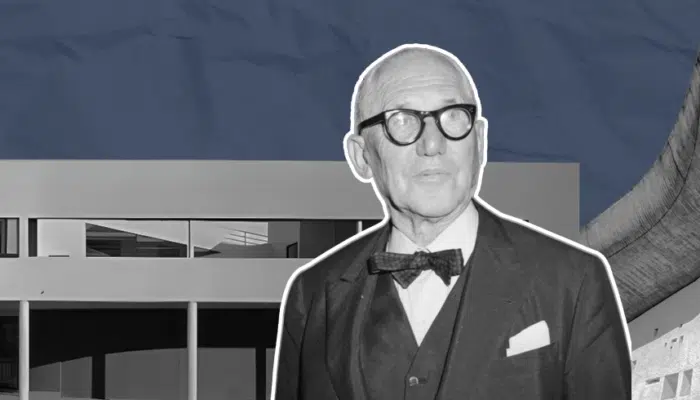
Le Corbusier — one of the most influential architects of the 20th century, a reformer of thinking about space, functionality, and form. He changed the course of architecture by placing the human — their needs, rhythm of life, freedom — at the center of everything.Le Corbusier; Charles-Édouard Jeanneret-GrisIt was he who introduced the concept of modern housing as a "machine for living." Space was no longer a decoration. It became a tool for comfort, efficiency, and freedom. Le Corbusier believed that true beauty lies not in ornaments and excesses, but in the functional appropriateness of every detail.His phrase became symbolic: "My favorite chair is the pilot's seat."When he first saw an airplane in the sky over Paris in the spring of 1909, Le Corbusier called this moment the most important in his life. He understood: the airplane is a perfect example of architecture where every form is subordinate to the task. There is nothing superfluous, nothing accidental. Only what is necessary for flight.Then he realized: placing a decorative statue on the facade of a modern house is as absurd as decorating an airplane with sculptures.Villa Savoye in Poissy (France; 1928-1930). Architect Le CorbusierThis principle became the core of his approach. And today — part of HutJet's philosophy.Catholic cathedral in Ronchamp. Architect Le CorbusierHutJet's prefab houses are a continuation of the legendary architect's ideas. Architecture where every centimeter makes sense. Where space works for people, not vice versa. Where there is nothing superfluous — but everything needed for living with comfort, freedom, and flexibility.HutJet Houses Easily Adapt to your Needs:change layouts;expand with new modules;easily relocate in case of a change in place or lifestyle.This is not just a beautiful form. It's living architecture that changes with you. As in the airplanes of the early 20th century, every detail here is an answer to the question "why".HutJet model T3HutJet model T2HutJet is architecture that works.Visit our showroom of ready-made houses and see for yourself:📍 Kyiv, 101 Stolychne Highway, Domosfera Shopping Centerhttps://youtu.be/mTPtb3OfE-g?si=QXqPdnyGSl2d5LaP
Architecture that Makes Sense: HutJet’s Philosophy through the Lens of Santiago Calatrava’s Ideas
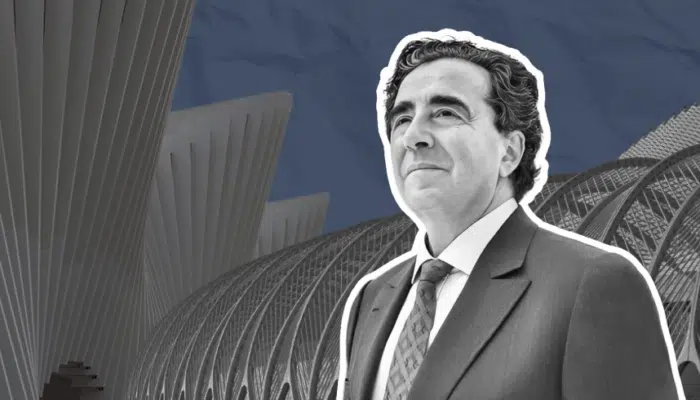
Architecture is more than form. It is space that lives, breathes, and changes with you. This idea has been conveyed for decades by one of the most influential architects of our time — Santiago Calatrava. His philosophy has become close to HutJet as well. Because we are convinced: a home is not just a building. It is a dialogue with nature, space, and human needs.Space That Speaks with Nature"Architecture should not simply stand on the ground. It must breathe like a living organism," Calatrava said. This is precisely the principle we have placed at the foundation of our houses. HutJet is not just structures. It is space integrated into the landscape. Space that respects nature, considers wind patterns, solar exposure, terrain, and human needs.HutJet model Sola XLEach of our houses is an extension of the environment. The same rhythm. The same energy. The same organic quality.Form for Life, not for Form's SakeCalatrava spoke simply: "Form for form's sake is sculpture. Architecture is form for life."SERGE ILLINThis is HutJet's philosophy. Every line, every structural element, every detail — none are accidental. They serve comfort, functionality, durability, and the sense of space. There is nothing superfluous here. Everything here is for you. For your rhythm of life, for your comfort, and for your future.Kitchen HutJet model Sola XLWhen Space Has ValueSantiago Calatrava once refused to simplify one of his projects, saying: "When you look at great cathedrals, does it concern you how much they cost? Or are you amazed that they exist?"This answer mirrors our approach. HutJet does not create square meters. We create space where you want to live. Space where function equals aesthetics. Where every detail is thoughtfully considered. Where there are no accidents. Where technology, design, and comfort work toward one goal — the quality of your life.Responsibility to People"An architect is not just an artist. We create the environment in which people live. And we bear responsibility for it," Calatrava said.HutJet fully shares this view. That is why we create houses that adapt to life, not the other way around. Houses that can change their area, location, and configuration. Space that grows with you.https://youtu.be/tk2PddwqTWQ?si=Sf1SVV-Ip0xXvhLgExperience HutJet's Philosophy in PersonWe invite you to our showroom in Kyiv — to see, feel, and hear what architecture that works for you looks like.📍 Stolychne Highway, 101, Domosfera Shopping Center
Serhiy Samusiev: HutJet — Dynamic House is a New Level of Freedom for those who Live there!
HutJet — Dynamic House is a construction company that has brought about a true revolution in architecture. Thanks to innovative prefab technology, HutJet architects led by company founder Serhiy Samusiev manufacture genuine "movable real estate" at their own high-tech factory. Now your home can move with you anywhere in the world — if it is created at the HutJet factory.Why does traditional construction fall short of innovative approaches? How much time does it take to manufacture a prefab house? And what are its main advantages? Serhiy Samusiev discussed this in a conversation with political expert and editor-in-chief of the "Khvylia" website Yuriy Romanenko.– I would like to first explain what problems I was trying to solve when launching this production. I have been in construction for more than a decade and came to the disappointing conclusion that it is impossible to build with quality in real construction conditions. First, weather conditions interfere, seasonality interferes. All this delays deadlines. Very low quality of project documentation... Overall, trying to respond to all these challenges, I came to understand that a quality house can only be built at a factory, in a workshop, - says Samusiev.But independence from climatic conditions is only one of the advantages of HutJet — Dynamic House. Speed of manufacturing plays a key role:– Overall, I can say that the houses we are talking about now represent a completely different level of freedom for the people who live there. The level of freedom lies in the fact that from the moment of ordering a house to the moment of moving in takes 2-3 weeks. In just 2 – 3 weeks after ordering a house, you can start living there.Another advantage of HutJet is mobility and flexibility:– A particularly important factor of our houses is that they can be assembled in one day and likewise disassembled in one day, transported and assembled at a new location. You can transport a house abroad, you can transport a house across the country. Place a house anywhere, and you don't even need a building permit. Formally, let's say, it is placed without a foundation or on a shallow foundation
Bauhaus. Architecture that Changed the World — and Became the Foundation of HutJet’s Philosophy
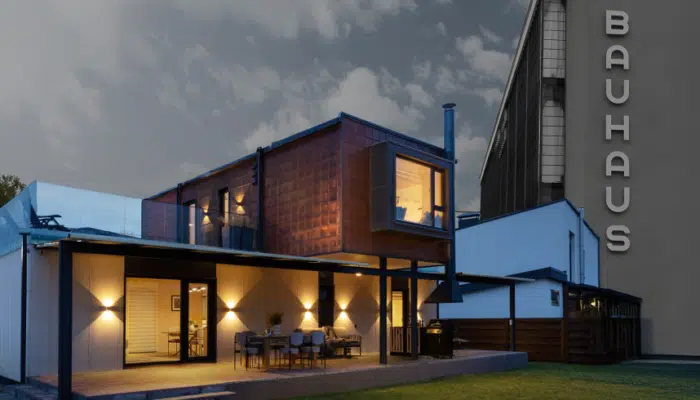
Bauhaus is not just a style. It's an entire philosophy that revolutionized architecture, design, and spatial thinking in the 20th century.One of the Bauhaus school buildings in Dessau, designed by Walter Gropius in 1925.The Bauhaus school was founded in Germany in 1919 by architect Walter Gropius. It was not just an educational institution, but a progressive creative movement that united architects, artists, engineers, and craftsmen for a common goal — to create objects and buildings that would be maximally functional, technological, and aesthetic simultaneously.Architect Walter GropiusBauhaus rejected the superfluous. No ornaments for ornament's sake. No luxury that exists purely for visual effect. Instead — clean lines, open planes, natural light, rational forms, perfect balance between beauty and function.It was here that the idea was first established: architecture should serve people, not the other way around. Space should be adaptive to life, convenient for work, rest, and development. It's not people who should adapt to the house — the house should adapt to people.Bauhaus Complex in Dessau. T. FranzenBauhaus and the Birth of Prefab ArchitectureBauhaus principles became the foundation for industrial architecture development. The idea of manufacturing not just furniture, but entire houses in factory conditions is a direct continuation of these approaches. Where traditional construction depends on weather, human factors, and endless delays, prefab technologies offer something different: precision, speed, quality control at every stage.A house created using prefab technology is an engineering product. It is designed as a system. As in Bauhaus, every detail here is well-thought-out, every solution is functional. And simultaneously — aesthetic lines, natural materials, honesty of form.How It's Implemented in HutJetHutJet continues these ideas at a new level. We create not just houses, but dynamic architectural solutions. Space that adapts to life: changing area, location, function. Housing that can not only be built but also relocated, expanded, or transformed when your life changes.HutJet model ShiftWe design each house as a single integrated object. There's no compromise between beauty and practicality. Only integrated solutions, only space that works for people.https://youtu.be/cio2O3bTm2A?si=3YK9Bf-_jKa4SFjlJust as Bauhaus proclaimed a hundred years ago: “Form follows function.” We add: "Form follows you."HutJet — space that lives with you.
“First We Shape our Buildings, then They Shape Us.” Winston Churchill
These words of the great English statesman remain relevant today. Indeed, the space we live in truly shapes our thinking, mood, and way of life. A home is not just a structure. It's an environment that affects us daily: limiting or, conversely, giving a sense of freedom. It promotes ease - or forces constant adaptation.Sir Winston Leonard Spencer-Churchill - British politician, statesman of the 20th century.This very idea forms the foundation of HutJet's philosophy. We are convinced: architecture should work for people, not the other way around. A house shouldn't dictate the rules of life - it should adapt to the rhythms, habits, and dreams of its owner.That's why our prefab houses are more than just square footage. It's a dynamic space that changes with you. HutJet houses are easily expandable, adaptable, and transformable. Today - it's a compact studio for one person. Tomorrow - a spacious family home with additional modules. And later - a new location and stage of life, where the house will move with you.https://youtu.be/tyK8nSXYnHU?si=yi72KFZ0PGuxg4KmWe build spaces that don't limit. On the contrary - they support freedom, ease, and the ability to change your life as you wish.This is the architecture of a new generation. Architecture that shapes space. And shapes the feeling of a life full of possibilities.HutJet - space that works for you.
Architecture of Freedom: Prefab as the Evolution of Housing that Has Already Become Reality
In today's world, speed, flexibility, and quality are no longer a choice but a standard. The same applies to housing that doesn't limit but adapts to your life. This is the essence of prefab — architecture that works to your rhythm and needs.HutJet houses are next-generation architecture. Not just a structure, but a space created for people, not for complex construction processes. Built in the factory with precision craftsmanship, these houses are delivered to your site ready — and assembled in a matter of hours.Prefab is not a compromise. It's technology that provides more possibilities, more freedom, and more comfort.A Home That Works for You — Not the Other Way AroundA house is more than a roof and walls. It's an environment that shapes our life rhythm, provides freedom or, conversely, limits it. That's why prefab is architecture created for people, not for complex construction processes.https://youtu.be/17_TwLUUANc?si=MRuVIx0VOWNfAXdWHousing should adapt to you. And with HutJet, this is possible. Want changes — add another module. Need more space — reconfigure the layout. Changed your living location — move the house with you.Prefab — Not a Compromise, But a New Level of FreedomHutJet prefab houses have no compromises. They combine:- architecture that flexibly adapts to your needs;- engineering that guarantees durability;- technologies that simplify life.https://youtu.be/aFRLEcvITp0?si=MtiSu-drCoS8SQMsThis is not just convenience. It's a lifestyle where freedom is not a metaphor but real functionality of your home.HutJet — architecture that changes the rules of the game. And creates space that changes you.